



Tubes and pipes are used not only to transport fluids but also across various industries. They are widely used in construction, furniture, automotive, and industrial frameworks. Structures, fences, machinery, and support systems often use steel and aluminum tubes. Achieving precise cuts can be challenging. That’s where a tube cutting machine comes in.
As designs become more complex, you need accurate, repeatable cutting. Speed is equally important. It is important, especially when dealing with a large volume of orders. In this article, we will provide a complete guide about lasers and other traditional tube-cutting machines. Ultimately, this guide will help you decide the best method for your project.
Understanding the Main Types of Tube Cutting Machines
A tube cutting machine is meant for cutting tubes. It can cut plastic, aluminum, copper, or steel tubes into precise shapes. More specifically, it can precisely cut tubes to exact length and shape. They are widely used in nearly every industry. Manufacturers produce them for use in vehicles, various structures, or appliances.
You can cut tubes in two main ways: mechanically or thermally. Mechanical cutting is a traditional method. Thermal cutting is more advanced, more accurate, and widely used in the metal fabrication industry.
Mechanical cutting may include saw cutting, band sawing, abrasive sawing, rotary cutting, or shearing. For simple straight cuts, these methods are quite cost-effective and efficient. However, for complex cuts, these methods may not be suitable. Besides, mechanical tools often wear out, requiring frequent replacement or maintenance.
Thermal cutting involves cutting by applying intense heat to materials. It may include gas, plasma, and laser tube cutting. Gas cutting is cheaper and easier to operate. On the other hand, the plasma cutting setup is complex but can be used for heavy-duty cutting. Laser tube cutting is more accurate and ideal for thin- to medium-thickness tubes. Laser cutting is well-suited for delicate components.
Choosing the proper method for your project may require careful consideration. Compare the benefits and limitations of each technique. You will find the best possible tube-cutting method for your work.
How Laser Tube Cutting Machines Work
Time is critical in manufacturing. In the tube/pipe industry, it is no exception. Higher production speeds directly reduce the cost per part. In this case, a laser tube cutting machine delivers high-speed, accurate cutting and less post-processing.
The tube cutting process generally begins with programming the device. You will need to insert the design into your CNC tube cutter system first. Then, the tube is secured in chucks or clamps. It holds the tube safely and rotates it accordingly.
Once it rotates, the high-power laser beam instantaneously removes or vaporizes materials along its path. This way, the tube is cut, and you get the exact sizes and shapes you need.
Usually, for metal tubes with standard (regular sizes) thickness, a standard tube-cutting machine with 1000W to 2000W should be enough. For thicker materials, you might need to opt for a 3000W or higher model.
A laser tube cutting machine is a modern solution for complex geometric shapes. People use it in many industries. Typically, automatic pipe-cutting machines are common in aerospace, medical, construction, and other sectors.
Using this equipment, you can create architectural trusses, fitness tools, bicycle frames, and exhaust systems. Also, it supports cutting a wide variety of materials. It works well with steel, stainless steel, aluminum, copper, and brass.
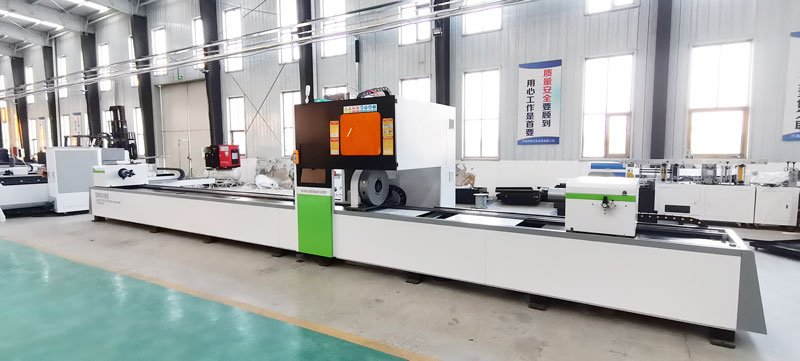
Main Types of Laser Tube Cutting Machines by Processing Method
The variation of laser tube cutting machines comes with their methods. Each process may differ, but the primary goal remains the same. Complex manufacturing challenges need advanced cutting technologies. Thus, different types of laser tube-cutting machines are needed. Each type suits specific project needs.
Automatic Loading & Unloading Tube Laser
Automatic loading and unloading tube laser machines are commonly designed for large-scale projects. It uses automation to increase efficiency. Its key benefit is its ability to handle a wide variety of integrated systems.
In the process, operators place tubes onto the feeding system. And the chuck holds, lifts, and aligns the tube without any manual intervention.
Then, the sensors measure their position and size, and the laser head begins cutting. It performs the entire process based on CNC programming. After cutting, finished tubes are perfectly unloaded into a collection area. It’s also a key advantage that saves time and avoids production delays.
Semi-Automatic Tube Laser
A semi-automatic tube machine combines manual and automatic processes. It offers human involvement for the cutting process. Here, the operator must place the tube on the main chucks. But the clamping and cutting process is automated.
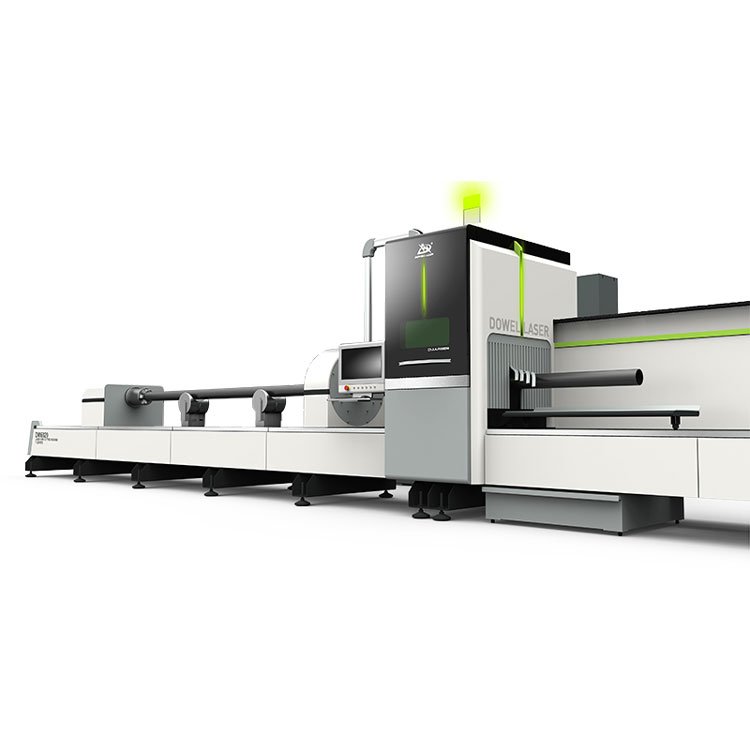
Dual-Chuck / Three-Chuck Tube Laser Machines
These tube laser cutters use multiple chucks. It mainly helps with zero tail material cutting to reduce material waste.
In two-chuck systems, one holds the material while the other rotates or moves it forward. Additionally, in a three-chuck system, an extra chuck lowers both vibration and material loss.
Generally, this equipment is used to reduce scrap. There is no material waste, saving material costs. In addition, they can produce parts with greater accuracy. Also, the cutting process is smooth and stable. As a result, this equipment is suitable for complex shapes and long tubes.
Plate & Tube Integrated Laser Cutting Machines
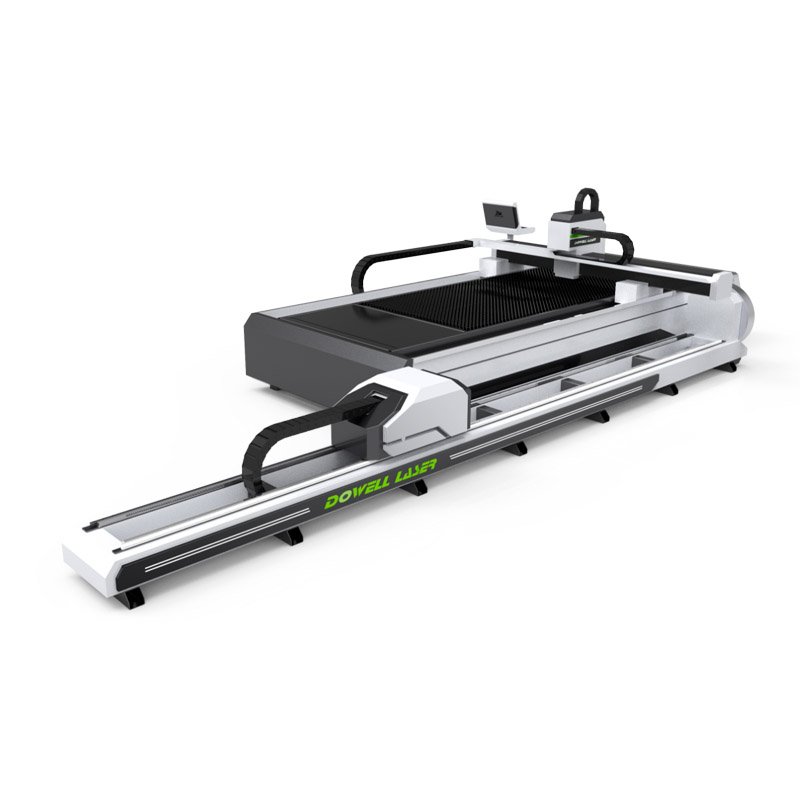
The Plate & Tube Integrated Laser Cutting Machine is a heavy-duty tube cutting machine. It offers versatility in cutting options. With it, you can cut both flat sheets and tubes.
For plate cutting, the laser moves along the flat worktable. For tube cutting, usually a rotary chuck holds and rotates the tube. The entire process is conducted using the same laser source and control system.
The main features of this cutting tool are a flat cutting bed and a rotary attachment. Such integration saves space and reduces overall costs. Factories do not need two separate tools for the job. It simplifies the planning and workflow, making it suitable for mixed workshops.
Key Advantages of Laser Tube Cutting Compared to Traditional Methods
Compared to traditional methods, laser tube-cutting machines offer many key benefits. There are many reasons why you should choose it over other methods. It is fast, repetitive, and stable.
When Laser Tube Cutting Is the Best Choice for Your Factory
A laser tube cutting machine is the best option for high-volume production. Besides, when it comes to creating complex designs, a laser cutting machine could be ideal. In just one setup, it can make perfect cuts, holes, and copings.
The typical tolerance of a laser cutting machine is ±0.1 mm, with minimal HAZ (heat-affected zone). This way, it ensures repeatable quality for every part.
When Traditional Tube Cutting Methods Might Still Be Suitable
Traditional methods are suitable for simple Straight cuts. In addition, it works well for low-volume productions. Its tolerance is ±0.5 mm or more, and there is a high risk of material warping due to heat during cutting. Generally, small workshop owners prefer it for low initial costs. You can consider traditional methods when the material thickness is higher. However, the process is relatively slow and can result in material waste.
Key Factors to Consider Before Choosing a Laser Tube Cutting Machine
The right equipment delivers the best results for your project. There are several factors to consider when choosing a laser cutting tool. To help you make the best choice, here are some key factors to consider. Otherwise, you won’t get its full benefits.
Material and Tube Size Range
When choosing a laser tube cutting machine, consider the material and its size. Different laser setups support different types of material. So, check its maximum or minimum supported ranges of tubes, shapes, or wall thicknesses. Make sure it supports your project’s needs.
Laser Power and Cutting Capability
Laser power is a crucial factor to consider. It is directly related to the device’s speed and cutting capability. High power can cut thicker material, while lower power is suitable for thin material. Choose power based on your material thickness and its types.
Automation Level and Production Volume
There is a wide variety of laser devices available on the market, including manual, semi-automatic, and fully automatic machines. Manual or semi-automatic machines suit small workshops and orders. In contrast, higher automation is ideal for large-scale projects. Select the option that best meets your production requirements.
Machine accuracy and Budgets
High accuracy ensures a clean edge and exact dimensions. Precision is more critical for tube laser cutting. So, check both the machine’s positioning and repeatability. Lastly, the primary concern is the budget. Check everything and choose a machine with the best efficiency in your budget range. It ensures the best return on investment (ROI) and optimal performance.
Conclusion: Making the Right Decision for Your Factory
Choosing the right tube cutting machine depends on your factory’s needs. If you want to work with complex shape designs, an automatic laser system is the best option. It will offer you unmatched speed and precision across large batches.
For smaller workshops, semi-automatic or conventional machines are ideal. Consider your budget and work needs, then approach with the right machines.
The whole article encompasses how and which one you should select. If you have any further queries regarding this topic, feel free to contact us. Our friendly team is always ready to assist you.